
Previously on Dear Dog Trainer…
Last week we talked about one of the biggest misconceptions in dog training: just because your dog can perform the command in your living room when you’re alone doesn’t mean they automatically understand it everywhere else.
Today, we’re tackling the second half of that question.
Let’s say you’ve done the work.
Your dog understands “sit” in the living room…
The kitchen…
The backyard…
Even the driveway.
So why does everything fall apart the second another dog walks by?
That’s where distractions come in.
A distraction is simply anything your dog finds more interesting than you in that moment.
Another dog.
A squirrel.
A toy.
The doorbell.
Even you moving around the room can become a distraction if your dog isn’t ready for it yet.
Distractions and the generalization we talked about last week go hand in hand. Much like with generalization, we build up gradually.
We need to do the same thing with distractions.
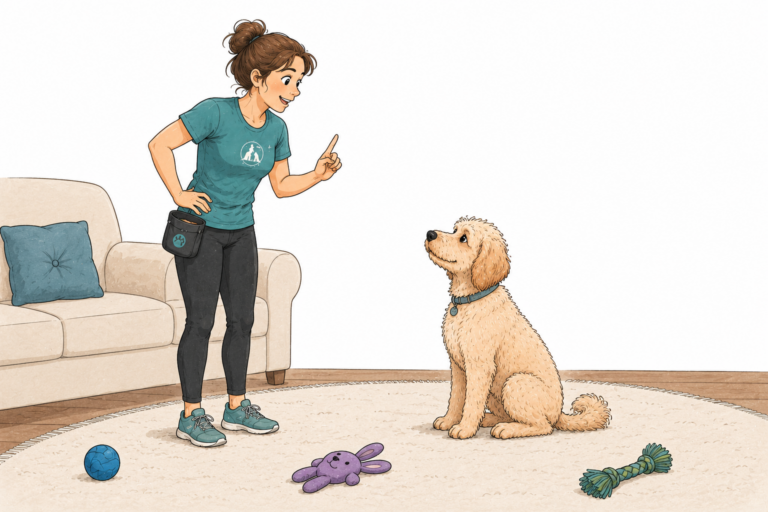
So when you’re working on your “sit” in the living room, start with just taking a few steps side to side in front of your dog, rewarding frequently when they are successful. Then release your dog.
That part is super important. Don’t wait for your dog to fail.
Release them and then have a party for success.
Then start again. Put your dog in a “sit” and slowly start seeing if you can take more and more steps. Build distance, try walking around them, etc. Reward each time you make the scenario more difficult.
If your dog struggles twice in a row, you made it too difficult and you need to go back a step or 2 to help them be successful.
Always end your session on a positive…on a win. Don’t let the last thing they did be a failure. Release them from their sit and party.
When you come back to work on it again either later that day or the next day, don’t start at the hardest part you left off on. Make it easier again to build success.
If you are now able to walk all around your dog, then we start increasing the distraction.
Even you moving around the room can become a distraction if your dog isn’t ready for it yet.
Walk a few steps.
Wave your arms.
Do a couple jumping jacks if you’re feeling ambitious.
(Your neighbors may question your life choices, but your dog won’t mind.)
I might start dropping toys (not throwing yet, remember to slowly increase the challenge level.) Reward successes. Then you can make the toy movement harder, or you can start dropping food. You can ask someone to ring the doorbell.
See the pattern?
Success after success.
That’s what we’re after.
Remember to keep your sessions short and positive. With practice, you will be able to take these skills to other rooms, outside, when people are over. The opportunities are endless.
The great thing is that this doesn’t just apply to “sit.”
You can use the exact same process with:
- down
- come
- place
- loose leash walking
The skill doesn’t matter.
The process does.
The goal isn’t to see how many distractions your dog can survive.
The goal is to build enough successful repetitions that those distractions stop feeling difficult in the first place.
When you slow down the process, your dog speeds up their learning.
-Your Friendly Dog Trainer